
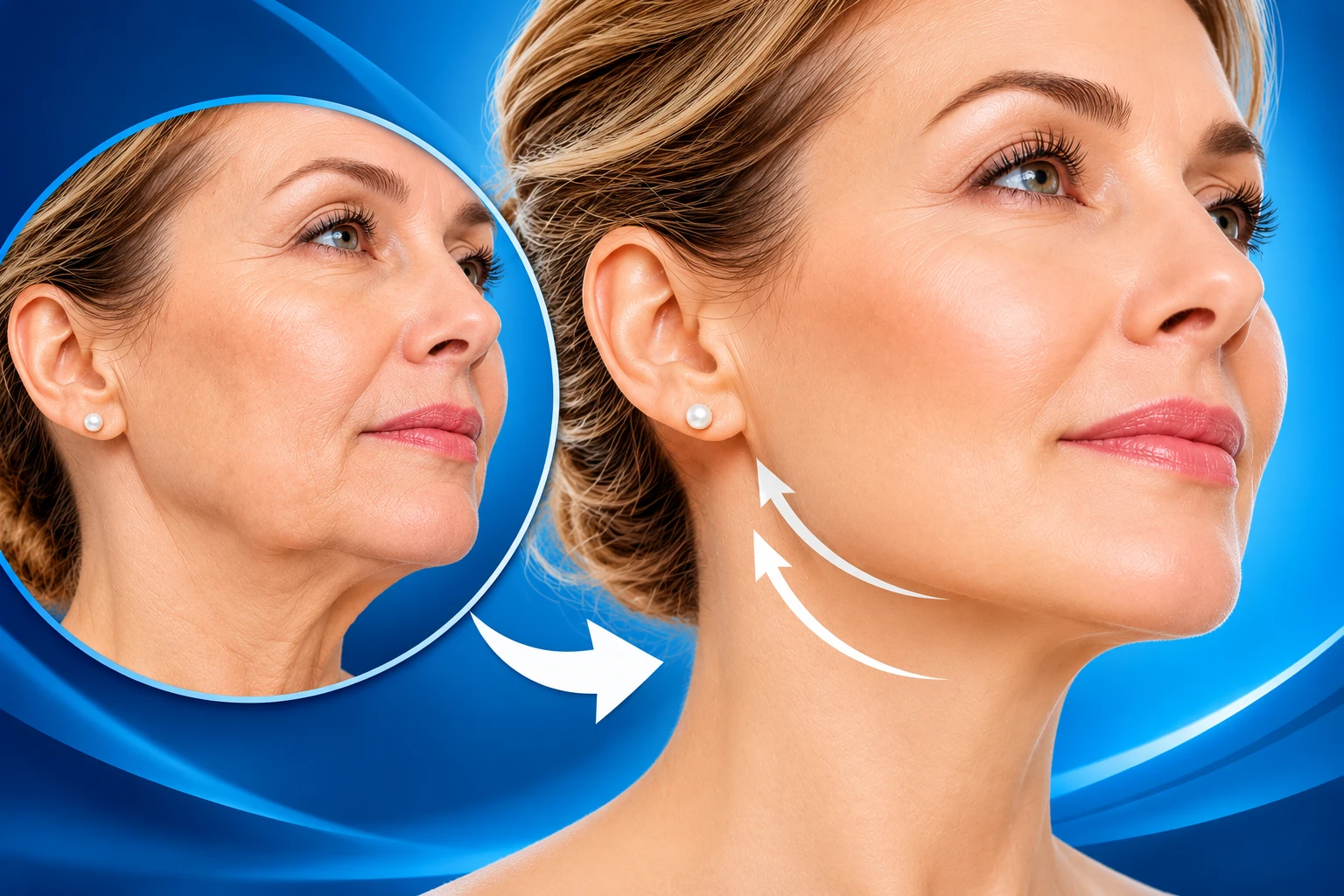
When the lower face starts to sag, the jawline softens, jowls form and the neck loses its definition, many people look for a lower facelift. The name is used in different ways by different surgeons, which makes it hard to know what is actually being offered. This guide explains what a lower facelift is, how it relates to a lower face and neck lift and a mini-facelift, who it tends to suit, what recovery involves, and what the alternatives are.
Quick Answer: What Is a Lower Facelift?
A lower facelift is a surgical procedure that focuses on the lower part of the face: the jawline, the jowls and often the neck. It repositions or removes skin, fat or muscle in those areas. Some surgeons use the name for a type of mini-facelift, so the exact technique, the incisions and the recovery depend on the surgeon. It does not treat the cheeks, eyes or forehead, and it cannot rebuild lost bone or volume.
What Is a Lower Facelift?
The Cleveland Clinic defines a facelift as a general term for any surgical procedure that improves signs of aging in the face or neck by repositioning or removing skin, fat or muscle. A lower facelift applies that idea to the lower face. It is usually discussed for jowls, a loss of jawline definition and loose skin or fat below the jaw.
Terminology varies. One plastic surgeon quoted by RealSelf describes the lower facelift as one type of mini-lift that works mainly on the jawline and neck (RealSelf on facelift types). Because the words are not standardized, always ask a surgeon exactly which layers they will work on, where the incisions will go and why that suits your face. Our guide to the types of facelifts explains the other names you may hear.
Lower Face and Neck Lift: How the Neck Fits In
The lower face and neck age together, so a lower facelift is often paired with a neck lift. The Cleveland Clinic describes a neck lift (platysmaplasty) as surgery that can remove excess fat and sagging skin from the neck and tighten the platysma muscle. It is typically an outpatient procedure, and recovery includes swelling and bruising, with muscle tightness in the neck that can last several months.
If your main concern is the neck, with visible bands or loose skin under the chin, ask whether a neck lift alone or combined with a lower facelift is the better plan.
Who Is a Good Candidate for a Lower Facelift?
A lower facelift is usually considered when:
- Jowls have formed along the jawline
- The jawline has lost definition
- There is early to moderate loose skin or fat in the lower face and upper neck
- The cheeks and midface are still reasonably well supported
The Cleveland Clinic says the more loose and excess skin you have, the more significant the surgery is likely to be, and that a mini-facelift focused on the lower face and neck is usually recommended for people with early signs of sagging. A surgeon should assess your skin, your fat and your facial structure in person or from detailed photographs, and should discuss your health and any risks.
Lower Facelift for Jowls: What It Can and Cannot Do
What it can do:
- Reposition or tighten tissue along the jawline and neck
- Remove excess skin or fat in the lower face
- Improve the definition of the jaw and the angle under the chin
What it cannot do:
- Rebuild lost bone or restore volume in a flat midface
- Treat the brows, eyes, forehead or nose
- Treat surface wrinkles, sun damage or skin color changes. The Cleveland Clinic says a facelift cannot do this, or stop the aging process
Our guide to sagging jowls and cheeks explains why jowls involve several layers, and why treating only one may fall short.
Lower Facelift vs. Mini-Facelift vs. Full Facelift
Mobile & Tablet: Swipe horizontally to compare all features
| Lower facelift | Mini-facelift | Traditional facelift | |
|---|---|---|---|
| Area treated | Jawline, jowls, often the neck | Lower face and neck | Face and neck |
| Often considered for | Jowls and jawline definition | Early signs of sagging | Moderate to significant aging |
| Cleveland Clinic notes | Not a standard category, so ask what is included | Quicker, less invasive; usually five to seven days off work | Incisions around the ears, hairline and chin; up to three weeks off work |
Many surgeons use “lower facelift” and “mini-facelift” to mean similar things, so compare what is actually planned, not the label.
Recovery, Results and Risks
The Cleveland Clinic says bruising and swelling after a facelift usually last about two to three weeks, and that it can take two to three months before your face feels back to normal. Most people return to work in five to seven days after a mini-facelift and in two to three weeks after a more invasive facelift. It advises avoiding strenuous exercise for at least three weeks, and says results usually last around seven to ten years, after which you keep aging.
The NHS says a facelift is usually done under general anaesthetic, that full recovery takes about 2 to 4 weeks, that the full effect can take 6 to 9 months to appear, and that results cannot be guaranteed (NHS facelift guide).
Clinical Note on Risks: The Cleveland Clinic lists rare risks that include anesthesia problems, infection, hematoma, changes in skin sensation, facial nerve injury, scarring and prolonged swelling. Discuss all of these with your surgeon before you decide.
Alternatives to a Lower Facelift
If your signs of aging are early or mild, or you do not want surgery, there are other routes. Each works on a different layer and has limits.
- Skin tightening. The Cleveland Clinic says focused ultrasound suits people in their 30s and older with mild to moderate skin laxity, with full results taking three to six months (Cleveland Clinic on Ultherapy).
- Thread lifts. The Cleveland Clinic says a thread lift creates subtle changes and typically lasts one to three years.
- Dermal fillers. The FDA says approved fillers can create a smoother or fuller appearance in areas that include the cheeks and chin, and that approval is for specific locations (FDA dermal fillers page).
- A non-surgical neck approach. The Cleveland Clinic notes that non-surgical neck options may need multiple procedures, and that their results are temporary.
Our guide to facelift alternatives compares these in more detail.
Where Bone and Structure Fit In
A lower facelift works on skin, fat and muscle. It does not change the bone beneath. If your lower face looks weak because the chin is recessed or the midface has lost support, tightening the tissue alone may not give the result you want.
Ben Sheng Gu Yuan, a clinic in Guangzhou, China, takes a bone-first approach to that layer. According to the clinic, it rebuilds bone first, repositions fascia second and tightens skin last, using 2–3 mm micro-punctures instead of incisions. Its chin program aims to regenerate native bony support without synthetic implants, and it tightens the soft tissue along the jawline. To be clear, the clinic’s treatment programs do not include a surgical lower facelift, and its approach is not designed for heavy skin excess. For significant jowls or loose neck skin, a surgical facelift is often the better answer. You can read how the method works in our guide to facial bone regeneration, and see how faces change over the years in our facial aging timeline.
Questions to Ask Your Surgeon Before a Lower Facelift
- 1. Which layers will you work on, and where will the incisions go?
- 2. What do you mean by “lower facelift”, and how is it different from a mini or full facelift?
- 3. Do I need a neck lift as well?
- 4. Is my jowl caused by skin, fat, support or bone?
- 5. What will recovery look like, and when can I return to work?
- 6. How long do your patients’ results last, and can I see cases from several years ago?
- 7. What happens if I am unhappy with the result?
Considering Treatment Abroad?
If you are thinking about having cosmetic treatment in another country, read our safety-first guide to plastic surgery in China before you plan a trip. It explains how cosmetic surgery is regulated and how to check any clinic.
Frequently Asked Questions
What is a lower facelift?
A lower facelift is a surgical procedure focused on the jawline, jowls and often the neck. It repositions or removes skin, fat or muscle in the lower face. Some surgeons treat it as a type of mini-facelift, so ask exactly what is included.
Is a lower facelift the same as a mini-facelift?
Not always. The terms overlap, and surgeons use them differently. The Cleveland Clinic describes a mini-facelift as a less invasive operation focused on the lower face and neck, so compare what is actually planned.
What is a lower face and neck lift?
It combines work on the jawline and jowls with a neck lift, which can remove excess fat and sagging skin and tighten the platysma muscle. It is often chosen when jowls and neck laxity appear together.
Does a lower facelift fix jowls?
It can improve jowls by repositioning or removing tissue along the jawline. It does not rebuild bone or volume, and it is not designed to treat the midface.
How long does a lower facelift last?
The Cleveland Clinic says facelift results usually last around seven to ten years, and that you continue to age afterwards. How long your result lasts depends on your skin, your lifestyle and the technique used.
What is the recovery after a lower facelift?
The Cleveland Clinic says most people return to work in five to seven days after a mini-facelift and two to three weeks after a more invasive facelift, with swelling that can take weeks to settle. Your surgeon will give you a timeline for your technique.
Can I get a consultation before traveling to Guangzhou?
Yes. Ben Sheng Gu Yuan offers a complimentary online consultation. You share photographs and your medical history and receive a preliminary assessment and cost estimate before you travel. The clinic can advise whether a bone-first program fits your concerns, but it does not perform surgical facelifts.