
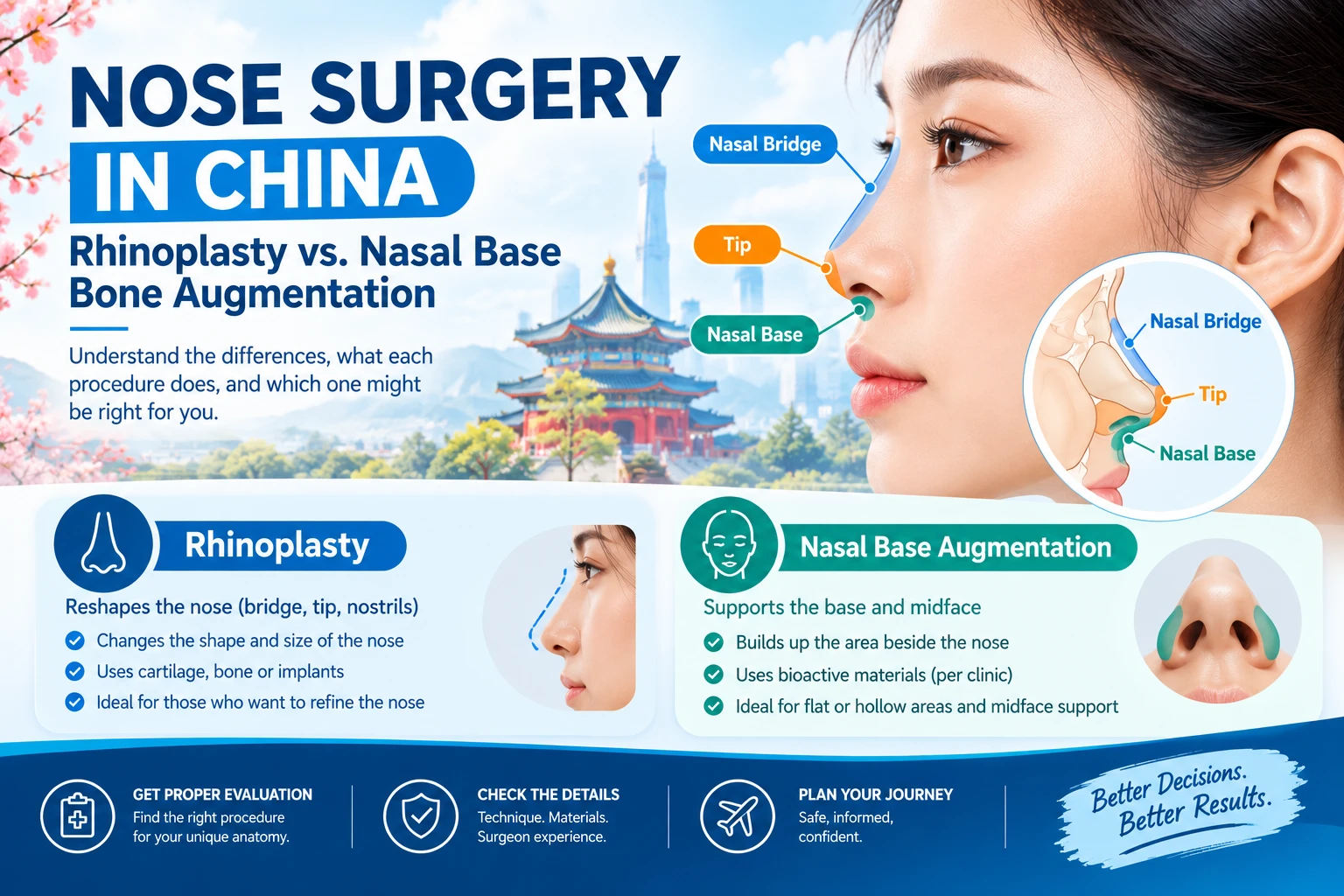
If you are researching nose surgery in China, the first question is not where to go but what you actually need. People often say they want a nose job when the real concern is the area around the nose: a flat midface, a hollow beside the nostrils or deep folds running down to the mouth. Those are different problems with different treatments. This guide explains what rhinoplasty does, what “Chinese rhinoplasty” means, how nasal base bone augmentation differs, and what to check before you book anything abroad.
Quick Answer: Rhinoplasty or Nasal Base Augmentation?
Rhinoplasty reshapes the nose itself: the bridge, tip, nostrils or overall size. It works on cartilage, bone and sometimes implants.
Nasal base augmentation targets the bone and support at the base of the nose and the midface, the area where the nose meets the cheeks and upper lip.
They are not interchangeable. A hollow or flat area beside the nose will not be solved by changing the bridge, and a low bridge will not be solved by building up the midface.
Many people need an assessment first. A surgeon should look at your profile and your facial structure before recommending either.
What Is Rhinoplasty?
The NHS describes rhinoplasty, or a nose job, as an operation to change the shape or size of the nose. The surgeon may make the nose smaller by removing cartilage and bone, or reshape it in other ways. The operation uses either a cut across the skin between the nostrils (open rhinoplasty) or tiny cuts inside the nostrils (closed rhinoplasty). The NHS also says results cannot be guaranteed, that there are risks, and that you may need up to two weeks off work to recover (NHS nose reshaping guide).
The British Association of Plastic, Reconstructive and Aesthetic Surgeons (BAPRAS) notes that rhinoplasty is one of the most common plastic surgery procedures, and warns that the nose is a delicate structure in which too much surgery can weaken and damage it (BAPRAS rhinoplasty guide).
What Is Chinese Rhinoplasty? Asian Rhinoplasty Explained
The phrase “Chinese rhinoplasty” does not describe one fixed technique. Searches for it usually mean rhinoplasty tailored to East Asian nasal anatomy, often called Asian rhinoplasty.
According to a review in the journal literature, most Asian noses have thicker skin and a lower bridge (dorsum), although there is considerable variation between populations. For patients with a low bridge, the review says surgeons agree that augmenting the bridge is necessary. Many use silicone implants, and others use the patient’s own cartilage, which the review reports has the lowest risk of infection among graft materials (Current Update in Asian Rhinoplasty). In practice, many Asian rhinoplasty patients seek to build up the bridge and define the tip, not to make the nose smaller.
The key point for anyone considering a trip is to ask which technique and which materials a surgeon plans to use, and why they suit your anatomy.
Nasal Base Bone Augmentation: A Different Approach
Nasal base work does not reshape the nose. It looks at the bone and support at the base of the nose and the midface. This matters because the facial skeleton changes with age. A 2017 study in Plastic and Reconstructive Surgery compared CT scans of the same people at least nine years apart. It found bone resorption in every patient at the pyriform aperture, the bony opening of the nose, and at the front wall of the upper jaw (PubMed abstract). When that support recedes, the area beside the nose can look flat or sunken. Researchers still debate how large a role bone plays compared with skin and fat, so it is one factor among several.
Ben Sheng Gu Yuan, a clinic in Guangzhou, offers a nasal-base osseous regeneration and shaping program. The clinic uses it for nasal-base depression, midface collapse, a protruding-mouth appearance caused by a recessed midface, and deep nasolabial folds. According to the clinic, a bioactive biomaterial is placed on the bone surface through 2–3 mm micro-punctures, with no surgical incisions or stitches.
The six programs on the clinic’s services page do not include reshaping the bridge or tip of the nose, so confirm with the team what a nasal-base program can and cannot change.
Rhinoplasty vs. Nasal Base Augmentation: Side by Side
| Feature | Rhinoplasty | Nasal base bone augmentation |
|---|---|---|
| What it changes | The shape and size of the nose: bridge, tip, nostrils | Bone support at the base of the nose and the midface |
| Typical access | Cuts across or inside the nose (open or closed) | 2–3 mm micro-punctures, per the clinic |
| Materials | Your own cartilage, bone or implants | A bioactive biomaterial placed on the bone, per the clinic |
| Often considered for | Low or high bridge, tip shape, nose size | Flat or hollow area beside the nose, midface collapse, deep nasolabial folds |
| Not designed for | A hollow midface caused by bone loss | Reshaping the bridge or tip, or heavy skin excess |
How to Tell Which One You Need
Only an assessment can say, but these questions help you prepare:
- Look at your side profile. Is the concern the height of the bridge or the shape of the tip? That points toward rhinoplasty.
- Look at the area beside the nose. Does it look flat, sunken or hollow, with deep folds toward the mouth? That points toward midface or nasal base support.
- Think about when it started. A flat or hollowed look that has grown over the years can reflect volume and bone changes, not the nose itself.
- Notice how your mouth sits. A recessed midface can make the mouth look more prominent.
- Ask about both. Some people benefit from addressing the nose and the midface together, and a good surgeon will say so.
If your concern also includes sagging in the lower face, our guide to sagging jowls and cheeks explains how the layers of the face work together.
Nose Surgery in China: What to Check Before You Book
The same rules apply to any country: verify before you pay. Our safety-first guide to plastic surgery in China covers how cosmetic surgery is regulated and how to check a clinic. For nose surgery in particular, ask:
- Which technique and which materials? If an implant is involved, ask for its name, who makes it and its registration status.
- Who will perform the surgery, and how many procedures like yours have they done?
- What will my result realistically look like? Ask for imaging or a written plan, not promises.
- What is the revision policy? The NHS notes that cosmetic surgery can sometimes go wrong and results may not match what you expected, so know in advance what happens if you need a correction.
- How long should I stay, and what is the plan for swelling and follow-up after I fly home?
- How do I reach the team after I leave? The CDC advises travelers not to delay care if they suspect a complication, so have a plan for that (CDC medical tourism guidance).
How Much Does a Nose Job in China Cost?
There is no single price. The cost depends on the type of surgery, the materials, the hospital and the surgeon. A fair comparison includes the treatment and hospital fees, the consultation fee, accommodation, interpreter and transfer services, flights and follow-up. Be cautious about any provider that quotes a firm figure without examining your case.
Ben Sheng Gu Yuan lists four concierge packages from $1,000 to $5,000 on its pricing page. They cover escort and concierge services, and your treatment estimate is provided after your online consultation.
Frequently Asked Questions
Is nose surgery in China safe?
Safety depends on the institution, the surgeon and the procedure. Check the licence, the surgeon’s qualifications, the registration of any implants, and the aftercare plan before you travel.
What is Chinese rhinoplasty?
It usually means rhinoplasty adapted to East Asian nasal anatomy, which often involves building up a low bridge and defining the tip, using implants, the patient’s own cartilage or both.
Can bone augmentation change the shape of my nose?
Nasal base augmentation works on the support around the base of the nose. It may change how the area around the nose looks, but it does not reshape the bridge or tip. Confirm with the surgeon what to expect.
Is a nose job the same as nasal base augmentation?
No. A nose job reshapes the nose. Nasal base augmentation treats the bone and support beneath and beside it.
Can I have a consultation before traveling to China?
Yes. Ben Sheng Gu Yuan offers a complimentary online consultation. You share photographs and your medical history and receive a preliminary assessment and cost estimate before you travel.
How far in advance should I book?
The clinic recommends that international patients schedule 2 to 4 weeks ahead, because surgical slots are limited.